


SEO for home health care agencies is the process of improving your website and online listings so families searching for care can actually find your agency before they find your competitors. Home care is a local, trust-driven decision, and most families start that decision with a Google search rather than a phone book or a referral card. If your agency does not appear on the first page of results, you are likely losing patients to a competitor who ranks higher, even if your care quality is superior.
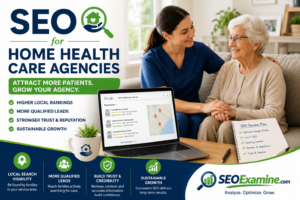
This guide walks through what SEO for home health care agencies actually involves, why it matters for growth, and which local SEO tactics move the needle fastest. We will also cover common mistakes agencies make, a realistic implementation timeline, and how a dedicated partner like SEOExamine can support the process from audit to ongoing reporting.
What Is SEO for Home Health Care Agencies?
SEO for home health care agencies means optimizing your website, Google Business Profile, and content so search engines understand what services you offer and where you offer them. When someone searches “home health care near me” or “in-home care for elderly parents,” search engines match that query against agencies with strong, relevant, and locally verified online signals. Consequently, agencies with better SEO tend to appear higher in both map results and organic listings.
Unlike national e-commerce SEO, home health care SEO is almost entirely local. Families rarely search for a provider three states away; instead, they search for help within a specific city, county, or service radius. Therefore, the strategy has to prioritize location-based keywords, verified business listings, and content that answers the specific questions caregivers and family members ask during a stressful decision.
Why SEO Matters for Home Health Care Agencies
Home health care is a high-intent, high-emotion search category. Families are often searching under pressure, right after a hospital discharge or a difficult diagnosis, and they tend to choose from whichever agencies appear fastest and look most credible. As a result, visibility in search results directly influences which agencies get the phone call.
Additionally, referral sources such as hospital discharge planners and case managers frequently Google-check an agency before recommending it. If your website looks outdated or your Google Business Profile has few reviews, that referral may quietly go elsewhere. Strong SEO for home health care agencies therefore supports both direct patient inquiries and professional referral relationships.
Competition among home health providers has also grown steadily, particularly as more families choose in-home care over facility-based options. Consequently, agencies that once relied heavily on word-of-mouth referrals now find themselves competing directly with well-optimized websites in local search results. Standing still, in this environment, effectively means falling behind.
Beyond attracting new patients, SEO also supports staffing and hiring efforts. Prospective caregivers often research an agency online before applying, and a professional, well-ranked website can strengthen your reputation as an employer. Therefore, the benefits of SEO for home health care agencies extend well past patient acquisition alone.
Why Local SEO Matters Specifically for Home Health Care Providers
Local SEO for home health care providers is the backbone of this entire strategy because care is delivered in person, within a defined service area. Search engines use signals like your business address, service area settings, and local citations to decide which agencies to show for “near me” searches. Without accurate local signals, even a beautifully designed website may never appear in front of nearby families.
Furthermore, Google’s local algorithm weighs proximity, relevance, and prominence. Proximity is largely out of your control, but relevance and prominence are not. Optimizing your Google Business Profile for home health care, gathering authentic reviews, and building local citations all improve prominence, while clear service descriptions improve relevance.
According to Google Business Profile Help, businesses with complete, accurate profiles are more likely to be considered trustworthy by both users and search algorithms. This matters even more in healthcare-adjacent categories, where families are naturally cautious before inviting a caregiver into their home. As a result, thorough local optimization does double duty by improving both rankings and first impressions.
It also helps to understand how Google Search Central describes ranking factors more broadly, since local SEO does not operate in isolation from general search quality guidelines. Fast-loading pages, clear content, and mobile usability all still matter, even when the primary goal is local visibility.
12 Practical SEO Tactics for Home Health Care Agencies
1. Claim and Fully Optimize Your Google Business Profile
Your Google Business Profile for home health care is often the first thing a family sees. Fill out every field, including services offered, service areas, hours, and a detailed business description. Then, add photos of your team, office, and vehicles to build trust before a single word is read.
2. Target Realistic Home Health Care Keywords
Effective keyword research goes beyond “home health care.” Families also search for phrases like “24 hour home care near me,” “Medicare home health agency near me,” “private duty home care,” and “non-medical home care services.” Mapping these phrases to specific pages helps search engines match your site to real searches.
3. Build Dedicated Service Pages
Instead of one general services page, create individual pages for skilled nursing, personal care, companion care, and respite care. Each page should describe the service clearly, list who it helps, and include a call to action. This structure also supports internal linking, such as connecting a services page to /local-seo-services/.
4. Create Location Pages for Every Service Area
If your agency serves multiple cities or counties, build a dedicated page for each one rather than a single vague “areas we serve” list. Mention neighborhood names, nearby hospitals, and local landmarks naturally. This approach strengthens your visibility for “home health care near me” searches across every town you actually serve.
5. Optimize for “Near Me” and Urgent-Need Searches
Many families search during a crisis, using phrases like “emergency home care near me” or “same day caregiver.” While outcomes cannot be guaranteed, your content can clearly explain your intake process and typical response times so anxious searchers understand what to expect next.
6. Publish Helpful, Original Content
Blog posts answering questions like “What is the difference between home health care and home care?” build authority over time. Because these topics are searched frequently, well-written answers also tend to earn featured snippets, which increase visibility even further.
7. Add a Robust FAQ Section to Key Pages
FAQ content matches how people actually phrase their concerns, such as “Does Medicare cover home health care?” Structured FAQs also give search engines clear, extractable answers, which can improve rankings for question-based searches.
8. Prioritize Mobile Usability
Most local searches happen on a phone, often while someone is sitting in a hospital waiting room. If your site loads slowly or buttons are hard to tap, visitors will leave before calling. A mobile-friendly design is therefore essential, not optional, for home health care SEO services.
9. Fix Technical SEO Fundamentals
Technical issues like broken links, duplicate title tags, or missing schema markup quietly hurt rankings. Running a technical audit, similar to the process outlined at /technical-seo-audit/, helps catch these problems before they cost you visibility.
10. Improve Page Speed
Slow-loading pages frustrate visitors and can lower rankings. Compressing images, enabling caching, and choosing reliable hosting all contribute to a faster experience, particularly for mobile visitors browsing on cellular data.
11. Actively Generate and Respond to Reviews
Reviews heavily influence both rankings and family trust. Ask satisfied clients and their families for feedback after a positive experience, and respond to every review, positive or negative, in a professional tone. This consistent activity signals to Google that your business is active and trustworthy.
12. Build Local Backlinks and Citations
Getting listed accurately on directories, local business associations, and healthcare networks builds citation consistency, which supports local SEO for home health care agencies. Partnering with local senior centers or hospitals for a mentioned link can also strengthen authority.
13. Match Content to Search Intent
Someone searching “home health care cost” wants pricing guidance, while someone searching “home health care vs nursing home” wants a comparison. Writing content that matches the actual intent behind a query, rather than generic marketing copy, improves both rankings and conversion rates.
14. Strengthen Internal Linking
Linking service pages, location pages, and blog posts to one another helps search engines understand your site structure. It also keeps visitors exploring your site longer, which can indirectly support engagement metrics tied to rankings.
15. Use Clear, Compassionate Calls to Action
Every page should include a next step, whether that is “Schedule a Free Consultation” or “Call Our Care Team Today.” Because families are often emotional during this search, a warm, clear CTA performs better than aggressive sales language.
16. Track the Right Metrics
Monitor organic traffic, keyword rankings, Google Business Profile views, and phone calls generated from search. Reviewing this data monthly helps identify which pages and keywords are driving actual inquiries, not just visits.
Common SEO Mistakes Home Health Care Agencies Should Avoid
1. Ignoring the Google Business Profile
Many agencies claim their profile once and never update it again. Outdated hours, missing photos, or an incomplete service list can quietly push you below competitors who keep their profile active.
2. Using One Generic Services Page
Cramming every service into a single vague page makes it harder for search engines to match specific queries to your site. Separate pages perform better because they allow deeper, more targeted content.
3. Skipping Location-Specific Content
Agencies that only mention their headquarters city miss searches from every other town they actually serve. As a result, they lose visibility in nearby communities where real demand exists.
4. Neglecting Mobile Experience
A site that looks fine on desktop but breaks on mobile will frustrate the majority of searchers. Since most local searches happen on phones, this mistake directly costs inquiries.
5. Overlooking Reviews
Agencies sometimes assume good care alone will generate reviews naturally. In reality, most satisfied families need a gentle, direct request before they leave feedback.
6. Writing Thin or Duplicate Content
Copying the same paragraph across multiple location pages confuses search engines and can trigger duplicate content issues. Unique, locally relevant content performs significantly better.
7. Making Unverifiable Claims
Promising specific health outcomes or guaranteed results is not only inaccurate but can also raise compliance concerns. Content should stick to describing services and processes rather than implying medical guarantees. For agencies certified through Medicare, it also helps to keep messaging consistent with guidance published by the Centers for Medicare & Medicaid Services, rather than making independent coverage promises.
8. Ignoring Page Speed and Technical Health
Even strong content underperforms on a slow, technically broken website. Regular technical checks prevent small issues from compounding into major ranking losses.
9. Treating SEO as a One-Time Project
SEO is an ongoing process, not a single setup task. Agencies that stop optimizing after the first few months often see rankings slip as competitors continue improving.
How SEOExamine Can Help Your Home Health Care Agency
Building and maintaining strong home health care SEO services requires consistent, specialized attention that many busy agency owners simply do not have time for. SEOExamine focuses on healthcare and local service businesses, which means the strategy is built around how families actually search for care rather than generic templates.
Comprehensive SEO Audit
Every engagement starts with a full audit of your website, Google Business Profile, and existing content. This audit identifies technical issues, missing keywords, and gaps compared to competing agencies in your area.
Local SEO Strategy
Using the audit findings, SEOExamine builds a local SEO for home health care agencies plan tailored to your specific service areas, similar to the framework described at /local-seo-services/.
Google Business Profile Optimization
SEOExamine fully optimizes your Google Business Profile for home health care, including categories, service descriptions, photos, and posting cadence, so your listing stays active and complete.
Keyword Research
Rather than guessing, SEOExamine researches the exact phrases families in your area use, including service-specific and “near me” variations, to guide content decisions.
Content Strategy
From service pages to blog articles, SEOExamine develops a content plan that answers real caregiver questions while naturally incorporating your target keywords, an approach detailed further at /content-marketing-services/.
Technical SEO
Site speed, mobile usability, and structured data are all reviewed and corrected to ensure search engines can properly crawl and index your website.
Competitor Analysis
SEOExamine studies which agencies currently outrank you and identifies the specific gaps in content, reviews, or citations that are holding your site back.
Local Link Building
Earning mentions and backlinks from relevant local organizations strengthens your site’s authority in the eyes of search engines over time.
Conversion Optimization
Traffic alone does not grow an agency; SEOExamine also reviews calls to action, forms, and phone number placement so visitors take the next step toward becoming a client.
Ongoing Reporting
Monthly reports track keyword rankings, traffic, and lead sources, so you always know what is working and what needs adjustment.
Step-by-Step SEO Strategy Timeline
Month 1: Audit and Foundation
The first month typically covers the technical audit, Google Business Profile cleanup, and keyword research. This foundation guides every decision made in later months.
Month 2: On-Page and Local Optimization
Next, service pages and location pages are optimized or created, and citation building begins across relevant local directories. Meanwhile, technical fixes identified in the audit are implemented.
Month 3: Content Expansion
During this phase, blog content and FAQ sections are published to target additional keyword opportunities. At the same time, review generation efforts ramp up to strengthen Google Business Profile signals.
Month 4 and Beyond: Refinement and Growth
By this stage, early ranking data becomes available and can guide further content and link-building priorities. Because SEO compounds over time, consistent monthly work tends to produce steadier, longer-lasting results than short bursts of activity.
What Affects the Cost of SEO for Home Health Care Agencies
Costs vary based on several factors rather than a fixed price. The number of service areas and location pages needed plays a significant role, since more locations require more localized content. Additionally, the current condition of your website affects pricing; a site with major technical issues requires more upfront work than one that is already well-structured.
Competitive density in your market also matters. Agencies in highly competitive metro areas often require more sustained content and link-building efforts than agencies in smaller, less contested markets. Finally, the scope of ongoing work, such as monthly content volume and reporting depth, influences overall investment.
Agencies that stay informed through resources like the National Association for Home Care & Hospice often have a clearer sense of industry standards, which can also inform how content and messaging are shaped. Aligning marketing language with recognized industry expectations tends to build additional credibility with both families and referral partners.
Realistic Timeline for SEO Results
SEO is a long-term strategy rather than an instant fix. Many agencies begin noticing early movement in rankings and traffic within three to six months, though this varies by market competitiveness and starting point. Meanwhile, foundational work like Google Business Profile optimization can sometimes produce faster visibility improvements in local map results.
It is worth noting that no ethical SEO provider can guarantee specific rankings or timelines, since search algorithms change and competitors are also actively optimizing. Instead, a realistic goal is steady, measurable improvement in visibility, traffic, and inquiries over time.
Final Thoughts on SEO for Home Health Care Agencies
SEO for home health care agencies is not a one-time project but an ongoing investment in visibility, trust, and growth. Families searching for care deserve to find agencies that are prepared, credible, and easy to reach online. By combining strong local SEO, a well-optimized Google Business Profile, and consistent, helpful content, your agency can compete more effectively for the patients who need your services most.
If your current website is not generating the inquiries you expect, it may be time to review your strategy with a team that understands healthcare marketing specifically, as opposed to generic local business SEO.
Frequently Asked Questions About Home Health Care SEO
How is local SEO different from regular SEO for home care providers?
Local SEO focuses specifically on location-based signals, such as your Google Business Profile, service areas, and local citations, since care is delivered in person within defined communities.
How long does home health care SEO take to show results?
Most agencies begin seeing measurable movement within three to six months, though results vary depending on competition and the agency’s starting point.
Do I need a website for every service I offer?
Dedicated pages for each core service, such as skilled nursing or companion care, tend to perform better than a single combined page because they allow more specific, targeted content.
How important are Google reviews for home health care agencies?
Reviews are highly influential for both rankings and family trust, since they signal credibility and activity to both search engines and potential clients.
Can SEO help with Medicare-related searches?
Content can clearly explain general information about Medicare-covered services, though families should always verify specific coverage details directly with Medicare or their provider.
Is paid advertising necessary alongside SEO?
Paid advertising can complement SEO by providing faster visibility, but organic SEO tends to build more sustainable, long-term traffic over time.
What are the biggest mistakes agencies make with SEO?
Common mistakes include neglecting the Google Business Profile, publishing thin content, and treating SEO as a one-time task instead of an ongoing process.
Does SEOExamine specialize in healthcare-related businesses?
SEOExamine works with local service and healthcare-related businesses and tailors strategies around how families actually search for care providers.
How do I get started with SEOExamine?
You can request an initial audit and consultation to review your current online visibility and identify the most impactful next steps.
How is local SEO different from regular SEO for home care providers?
Local SEO focuses specifically on location-based signals, such as your Google Business Profile, service areas, and local citations, since care is delivered in person within defined communities.
How long does home health care SEO take to show results?
Most agencies begin seeing measurable movement within three to six months, though results vary depending on competition and the agency’s starting point.
Do I need a website for every service I offer?
Dedicated pages for each core service, such as skilled nursing or companion care, tend to perform better than a single combined page because they allow more specific, targeted content.
How important are Google reviews for home health care agencies?
Reviews are highly influential for both rankings and family trust, since they signal credibility and activity to both search engines and potential clients.
Can SEO help with Medicare-related searches?
Content can clearly explain general information about Medicare-covered services, though families should always verify specific coverage details directly with Medicare or their provider.
Is paid advertising necessary alongside SEO?
Paid advertising can complement SEO by providing faster visibility, but organic SEO tends to build more sustainable, long-term traffic over time.
What are the biggest mistakes agencies make with SEO?
Common mistakes include neglecting the Google Business Profile, publishing thin content, and treating SEO as a one-time task instead of an ongoing process.
Does SEOExamine specialize in healthcare-related businesses?
SEOExamine works with local service and healthcare-related businesses and tailors strategies around how families actually search for care providers.
How do I get started with SEOExamine?
You can request an initial audit and consultation to review your current online visibility and identify the most impactful next steps.
Ready to Improve Your Home Health Care Agency’s Visibility?
If you are ready to attract more local families and referrals through search, SEOExamine can help you build a strategy tailored to your service area. Contact our team today to request a free consultation and see where your current SEO stands.