


SEO for Pharmacies: Attract More Local Patients and Prescription Customers
SEO for pharmacies is exactly what your pharmacy needs when a nearby patient searches for a prescription refill, a trusted pharmacist, or same-day medication delivery. When someone needs a prescription filled today, they rarely open a phone book. Instead, they search Google for “pharmacy near me” or “prescription delivery near me” and pick from the first few results. If your pharmacy does not show up there, you lose that customer to a competitor.
In this guide, you will learn what pharmacy SEO actually means, why local SEO matters so much for pharmacies, and which strategies can help your pharmacy show up when nearby patients search for medication, refills, or a trusted local pharmacist. We will also explain how an experienced agency like SEOExamine approaches pharmacy SEO, so you can decide what level of support your pharmacy needs.
What Is SEO for Pharmacies?
SEO stands for search engine optimization. In simple terms, it means improving your website and online presence so that search engines like Google show your pharmacy to the right people at the right time.
SEO for pharmacies focuses on the specific searches that pharmacy customers actually use. These include terms such as “pharmacy near me,” “prescription refill,” “pharmacist near me,” and “local pharmacy.” Because these searches usually come from someone who needs help quickly, pharmacy SEO leans heavily on local search.
Good pharmacy SEO covers several areas at once. It includes your website content, your Google Business Profile, your local citations, your technical setup, and the reviews your customers leave. When these pieces work together, your pharmacy becomes easier to find, easier to trust, and easier to choose over a competitor.
Why SEO Matters for Modern Pharmacies
Pharmacy customers behave differently than they did even a few years ago. Many patients now search online before they ever walk through your door. As a result, your website and Google listing often form a customer’s first impression of your pharmacy.
Furthermore, large pharmacy chains invest heavily in digital marketing. Because of this, independent and small pharmacies need a smart SEO strategy to stay visible. Without it, chain pharmacies can dominate the search results, even in neighborhoods where a local pharmacy offers better service.
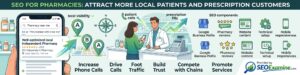
SEO also supports several practical business goals. For example, it can help you:
- Increase phone calls for prescription questions
- Drive more foot traffic to your physical location
- Build trust with new patients before they visit
- Compete more effectively against big-box pharmacies
- Promote services such as delivery, transfers, or consultations
In other words, SEO is not just a technical exercise. It is a direct path to more patients and more prescriptions filled at your counter.
Why Local SEO Is So Important for Pharmacies
Local SEO is a specific part of SEO that focuses on searches tied to a location. For pharmacies, this is often the most valuable type of SEO, since almost every pharmacy customer searches with local intent.
Think about how people actually search. They rarely type “buy medication online” when they need a same-day refill. Instead, they search “pharmacy open now” or “prescription pharmacy near me.” These searches show strong local intent, and Google responds by showing a map with nearby pharmacy listings.
Because of this pattern, local SEO strategies such as Google Business Profile optimization, consistent business information, and local reviews carry more weight for pharmacies than they might for other types of businesses. If your pharmacy ranks well locally, you appear in front of people who are ready to act right away.
Local SEO also helps smaller pharmacies compete fairly. A well-optimized independent pharmacy can outrank a national chain in local map results, especially when the chain’s local listing is incomplete or poorly managed.
1. Optimize Your Google Business Profile
Your Google Business Profile is often the very first thing a patient sees. Because of this, it deserves careful attention.
Start by claiming and verifying your listing if you have not already done so. Then, fill out every available field. This includes your pharmacy name, address, phone number, website, hours, and categories such as “Pharmacy” or “Drug Store.”
Add photos of your storefront, your team, and your interior. Pharmacies that show real photos tend to earn more trust than those with generic or missing images. Also, keep your hours updated, especially around holidays, since incorrect hours frustrate customers and hurt your ranking.
According to Google Business Profile Help, businesses that keep their information complete and accurate and use Google’s tools to interact with customers may see increases in customer engagement. This applies directly to pharmacies, since accurate hours and services help patients decide where to go.
2. Find the Right Pharmacy Keywords
Keyword research helps you understand exactly what your customers type into Google. Without this step, you risk creating content that nobody actually searches for.
Start with broad terms such as “pharmacy SEO” or “local pharmacy.” Then, narrow down to more specific phrases your patients might use. These often include:
- Pharmacy near me
- Prescription refill near me
- Pharmacist near me
- Independent pharmacy
- Pharmacy delivery service
- Medication consultation
Once you gather these keywords, group them by topic. This makes it easier to plan pages and blog posts later. Also, pay attention to keywords with local intent, since these tend to convert into calls and visits more often than general informational searches.
3. Create Dedicated Pharmacy Service Pages for Better SEO
Many pharmacy websites list every service on a single crowded page. Instead, each core service deserves its own page.
For example, if your pharmacy offers prescription delivery, create a dedicated page that explains how the service works, who qualifies, and how to request it. Similarly, if you offer medication consultations, build a page that outlines what patients can expect.
Dedicated service pages help in two ways. First, they give search engines a clear signal about each service you offer. Second, they give patients a direct answer when they search for that specific service. As a result, your pharmacy has a much stronger chance of ranking for those exact searches.
Remember, only promote services your pharmacy genuinely provides. Never imply a health outcome or promise results from a consultation, since this could mislead patients and create compliance issues.
4. Build Location Pages for Each Pharmacy
If your pharmacy operates more than one location, each one needs its own page. A single page that lists multiple addresses rarely performs well in local search.
Each location page should include the specific address, phone number, hours, and a short description of that location. Adding a map and directions also helps both patients and search engines understand exactly where you are.
Consequently, location pages allow each pharmacy branch to rank in its own neighborhood. This matters because a patient searching in one part of town should see the closest, most relevant location first.
5. Target “Pharmacy Near Me” Searches
“Near me” searches have grown dramatically over the past several years. These searches almost always come from someone who wants to act immediately, whether that means calling, visiting, or requesting a refill.
To capture these searches, your pharmacy needs strong signals of location relevance. This includes an optimized Google Business Profile, consistent address information, and location-specific content on your website.
At the same time, your website should load quickly and clearly display your address and phone number. When these elements align, Google has an easier time matching your pharmacy to nearby “pharmacy near me” searches.
6. Create Helpful Pharmacy Content
Blog content gives your pharmacy a way to answer common patient questions while also building topical authority. For instance, you might write about how prescription transfers work, what to expect from a medication consultation, or how to prepare for a flu shot visit.
Helpful content builds trust because it shows real expertise. However, it must stay factual and avoid medical claims. Instead of promising specific health outcomes, focus on general, accurate information, such as guidance from the FDA on medication safety or the CDC on seasonal immunizations, and encourage readers to speak with a pharmacist directly for personal advice.
Good content ideas include:
- How prescription refills work at your pharmacy
- What to bring for a prescription transfer
- How pharmacy delivery service works
- What questions to ask during a medication consultation
7. Build a Strong Pharmacy FAQ Section
An FAQ section helps patients find quick answers, and it also helps your pages target several related keywords at once. Questions such as “Do you offer prescription delivery?” or “Can I transfer my prescription online?” are exactly the type of queries patients search for.
Additionally, FAQ sections often appear in Google’s expanded search features, which can increase your visibility even further. Keep each answer short, direct, and honest. Avoid vague language, since clear answers build more trust with both patients and search engines.
8. Make Your Pharmacy Website Mobile-Friendly
Most pharmacy searches happen on a phone, often from someone standing in a parking lot or waiting at home for a refill. Because of this, your website must work smoothly on mobile devices.
A mobile-friendly pharmacy website should load quickly, display a clear phone number, and make directions easy to find. Buttons should be large enough to tap easily, and text should remain readable without zooming.
If your website feels difficult to use on a phone, patients will likely leave and choose a competitor instead. Since mobile experience also affects your search ranking, this step supports both usability and SEO at the same time.
9. Improve Technical SEO
Technical SEO covers the behind-the-scenes elements that help search engines understand and trust your website. While it sounds complex, the core ideas are fairly simple.
Your website should use a secure connection (HTTPS), have a clean site structure, and avoid broken links. It should also include proper heading tags, so search engines can understand what each page covers. Structured data, sometimes called schema markup, can further help by clearly labeling your business type, address, and hours.
According to Google Search Central, following general SEO guidelines can help Google find, index, and rank your site. For pharmacies, this technical SEO foundation supports every other SEO effort you make.
10. Improve Your Pharmacy Website Speed
Website speed affects both user experience and search rankings. A slow website frustrates visitors, especially those searching urgently for a nearby pharmacy.
To improve speed, compress large images, remove unnecessary plugins, and choose reliable hosting. Even small improvements can reduce load time significantly. Since patients often search while on the move, a fast website keeps them on your page instead of pushing them toward a competitor.
11. Build Trust With Genuine Customer Reviews
Reviews play a major role in pharmacy SEO, partly because they influence rankings and partly because they influence patient decisions. Before choosing a pharmacy, many people read recent reviews first.
Encourage satisfied customers to leave honest reviews after a positive experience. You might place a simple sign near the register or send a follow-up text with a review link. However, never offer payment or incentives for reviews, since this violates Google’s policies and can damage your credibility.
When you receive a review, respond to it. Thank positive reviewers, and address negative reviews calmly and professionally. This shows future patients that your pharmacy values feedback and takes customer service seriously.
12. Build Relevant Local Backlinks
Backlinks are links from other websites that point to yours. Search engines see these links as a form of trust, especially when they come from relevant, local sources.
For pharmacies, strong backlink opportunities include local news sites, community organizations, chambers of commerce, and health-related directories. You might also earn links by sponsoring a local event or partnering with a nearby clinic.
Because local backlinks reinforce your pharmacy’s presence in the community, they tend to carry extra weight for local search rankings. Even a handful of high-quality local links can make a noticeable difference over time.
13. Match Content With Search Intent
Search intent refers to the reason behind a search. Someone searching “pharmacy near me” wants quick, local results. Meanwhile, someone searching “how does prescription transfer work” wants a clear explanation, not just a phone number.
Your pharmacy’s content should match these different intents. Location and contact information should be easy to find for urgent searches. On the other hand, blog posts and FAQ pages should fully answer more detailed questions. When your content matches what searchers actually want, both engagement and rankings tend to improve.
14. Use Internal Linking
Internal links connect one page on your website to another. For example, a blog post about prescription refills might link directly to your refill request page.
This practice helps visitors navigate your site more easily, and it also helps search engines understand how your pages relate to each other. As a result, well-placed internal links can improve both user experience and overall SEO performance. Aim to link naturally within your content, rather than forcing links where they do not fit.
15. Optimize Prescription-Related Searches
Prescription-related searches deserve special attention, since they directly connect to your core business. Common examples include “prescription refill near me,” “prescription transfer,” and “prescription delivery near me.”
To capture these searches, create clear pages that explain each process step by step. For instance, a prescription transfer page should explain what information a patient needs and how long the process typically takes. Clarity matters here more than persuasive language, since patients want practical answers, not marketing copy.
Always avoid implying that any medication or service will treat, cure, or prevent a specific condition. Stick to describing your process and your services accurately.
16. Create Strong Calls to Action
A call to action, or CTA, tells visitors exactly what to do next. Without a clear CTA, even well-optimized pages can fail to convert visitors into patients.
Effective pharmacy CTAs include phrases such as “Call us to transfer your prescription” or “Request a refill online.” Place these CTAs near the top of key pages, and repeat them again near the bottom. Since many visitors decide quickly whether to stay or leave, a clear next step can make the difference between a lost visitor and a new patient.
17. Track Important SEO Metrics
Finally, tracking results helps you understand what is actually working. Useful metrics include local search rankings, Google Business Profile views, website traffic, phone calls, and direction requests.
Review these numbers regularly, ideally on a monthly basis. Over time, this data shows which pages, keywords, and strategies bring in the most patients. Consequently, you can adjust your approach instead of guessing what might work.
Common Mistakes to Avoid With SEO for Pharmacies
Even well-intentioned pharmacies make SEO mistakes that hold back their growth. Below are some of the most common issues.
- Inconsistent NAP information. When your name, address, and phone number differ across listings, search engines lose trust in your data.
- Ignoring Google Business Profile updates. Outdated hours or missing photos can turn away potential patients.
- Thin or duplicate content. Copying manufacturer descriptions or generic health text rarely helps your rankings.
- Slow website speed. A sluggish site frustrates visitors and increases bounce rates.
- No mobile optimization. Since most searches happen on phones, a poor mobile experience costs you patients.
- Missing location pages for multiple branches. Without them, individual locations struggle to rank locally.
- Ignoring reviews. Failing to respond to reviews, especially negative ones, damages trust.
- Overpromising results. Making medical claims or guaranteeing outcomes can create compliance risks.
- Keyword stuffing. Repeating keywords unnaturally can hurt readability and rankings alike.
- No tracking or reporting. Without data, it becomes difficult to know what is actually working.
Avoiding these mistakes puts your pharmacy in a much stronger position than many competitors who overlook them.
How SEOExamine Can Help Your Pharmacy
By now, you likely understand what pharmacy SEO involves and why it matters. Even so, executing a full strategy takes time, tools, and ongoing attention that many pharmacy owners simply do not have.
This is where working with an experienced team becomes valuable. SEOExamine specializes in local SEO for healthcare and pharmacy businesses, and the team focuses on turning search visibility into real patient calls and visits.
Pharmacy SEO Audit
Every engagement typically starts with a full audit of your website, Google Business Profile, and local listings. This audit identifies gaps, technical issues, and missed opportunities specific to your pharmacy.
Local SEO for Pharmacies
From there, the team builds a local SEO plan tailored to your service area, including citation cleanup, NAP consistency checks, and location-based content.
Google Business Profile Optimization
SEOExamine also manages Google Business Profile setup, ongoing updates, photo strategy, and review response support, so your listing stays accurate and competitive.
Pharmacy Keyword Research
Using real search data, the team identifies the exact terms your local patients use, then prioritizes them based on value and competition.
Pharmacy Content Strategy
Content planning includes service pages, FAQs, and blog topics designed to answer patient questions while supporting your target keywords.
Technical SEO
The team also handles technical improvements such as site speed, mobile usability, and structured data, ensuring your website performs well behind the scenes.
Competitor SEO Analysis
Understanding what nearby pharmacies and chains are doing helps shape a smarter, more competitive strategy.
Local Link Building
SEOExamine pursues relevant local backlink opportunities that strengthen your pharmacy’s authority within your community.
Conversion-Focused SEO
Traffic alone is not the goal. As a result, every page is reviewed with conversion in mind, from CTA placement to click-to-call functionality.
SEO Reporting and Growth Tracking
Finally, ongoing reporting keeps you informed on rankings, traffic, and lead activity, so you always know how your investment is performing.
A Step-by-Step Pharmacy SEO Strategy
A clear timeline helps set realistic expectations. While every pharmacy is different, a typical strategy might follow this general pattern.
Month 1: Foundation This stage focuses on the audit, Google Business Profile setup, technical fixes, and keyword research. Essentially, this month builds the base everything else relies on.
Month 2: Content and Local SEO Next, the team develops service pages, location pages, and initial blog content. At the same time, local citations and NAP consistency work continues.
Month 3: Authority and Growth During this phase, link building ramps up, and content expands further. Meanwhile, early performance data starts to guide adjustments.
Month 4 and Beyond: Continuous Optimization After the initial groundwork, SEO becomes an ongoing process. Regular content updates, review management, and performance tracking keep your pharmacy competitive over time.
How Much Does SEO for Pharmacies Cost?
Pharmacy SEO pricing varies widely, since no two pharmacies face the same situation. Several factors influence cost, including:
- Your location and level of local competition
- The number of pharmacy locations you operate
- The current condition of your website
- The specific services you want to promote
- How much new content your site needs
- Your overall growth goals
Because of these variables, it would be misleading to quote a fixed price without understanding your specific situation. Instead, the best approach is to request a custom strategy based on your pharmacy’s exact needs and market.
How Long Does Pharmacy SEO Take?
SEO is a long-term investment rather than an instant fix. While some improvements, such as Google Business Profile updates, can show results within weeks, meaningful ranking growth usually takes several months.
Most pharmacies begin to see noticeable movement within three to six months, although this timeline depends on competition and starting conditions. Importantly, no ethical agency can guarantee specific rankings, since search engines constantly update their algorithms. Instead, focus on steady, sustainable progress rather than instant results.
Final Thoughts
SEO for pharmacies is not a one-time task. Instead, it is an ongoing effort that combines local optimization, helpful content, technical performance, and genuine trust-building.
When done correctly, local pharmacy SEO helps your pharmacy appear in front of nearby patients exactly when they need you most. Whether someone searches for a prescription refill, a nearby pharmacist, or same-day delivery, a strong SEO foundation ensures your pharmacy shows up first.
While you can handle some of these steps internally, a dedicated pharmacy SEO strategy often performs better with expert support. If you would like guidance tailored to your specific pharmacy, SEOExamine can help you build a plan designed around your goals.
Frequently Asked Questions About SEO for Pharmacies
Why does local SEO matter for pharmacies?
Local SEO matters because most pharmacy searches come from people looking for immediate, nearby help. A strong local presence helps you appear in these time-sensitive searches.
How can a pharmacy rank higher on Google Maps?
Ranking higher on Google Maps usually involves optimizing your Google Business Profile, keeping your information consistent, and earning genuine local reviews.
Can SEO help independent pharmacies compete with large chains?
Yes. With a focused local SEO strategy, independent pharmacies can often outrank larger chains in local map results, especially when the chain’s local listing is poorly managed.
How long does pharmacy SEO take?
Most pharmacies see noticeable results within three to six months, although timelines vary based on competition and starting conditions.
How much does pharmacy SEO cost?
Cost depends on factors such as location, competition, number of locations, and website condition. A custom quote reflects your specific situation more accurately than a flat price.
Should pharmacies create separate service pages?
Yes. Dedicated service pages help both patients and search engines understand exactly what your pharmacy offers, which can improve rankings for specific searches.
Can SEO help pharmacies get more prescription customers?
SEO can help more patients discover your pharmacy when they search for prescription-related services, which can lead to more calls and visits, though results vary by pharmacy and market.
Does Google Business Profile help pharmacies?
Yes. An optimized Google Business Profile often serves as the first thing patients see, making it one of the most important local SEO tools for pharmacies.
Can SEOExamine help with SEO for pharmacies?
Yes. SEOExamine works specifically with local and healthcare-related businesses, offering audits, local SEO, content strategy, and ongoing optimization tailored to pharmacies.
Why does local SEO matter for pharmacies?
Local SEO matters because most pharmacy searches come from people looking for immediate, nearby help. A strong local presence helps you appear in these time-sensitive searches.
How can a pharmacy rank higher on Google Maps?
Ranking higher on Google Maps usually involves optimizing your Google Business Profile, keeping your information consistent, and earning genuine local reviews.
Can SEO help independent pharmacies compete with large chains?
Yes. With a focused local SEO strategy, independent pharmacies can often outrank larger chains in local map results, especially when the chain’s local listing is poorly managed.
How long does pharmacy SEO take?
Most pharmacies see noticeable results within three to six months, although timelines vary based on competition and starting conditions.
How much does pharmacy SEO cost?
Cost depends on factors such as location, competition, number of locations, and website condition. A custom quote reflects your specific situation more accurately than a flat price.
Should pharmacies create separate service pages?
Yes. Dedicated service pages help both patients and search engines understand exactly what your pharmacy offers, which can improve rankings for specific searches.
Can SEO help pharmacies get more prescription customers?
SEO can help more patients discover your pharmacy when they search for prescription-related services, which can lead to more calls and visits, though results vary by pharmacy and market.
Does Google Business Profile help pharmacies?
Yes. An optimized Google Business Profile often serves as the first thing patients see, making it one of the most important local SEO tools for pharmacies.
Can SEOExamine help with SEO for pharmacies?
Yes. SEOExamine works specifically with local and healthcare-related businesses, offering audits, local SEO, content strategy, and ongoing optimization tailored to pharmacies.
Ready to Grow Your Pharmacy’s Local Visibility?
Your next patient may already be searching for a pharmacy near them right now. If your website and Google listing are not fully optimized, that search could end with a competitor instead of your pharmacy.
SEOExamine helps pharmacies build a clear, ethical, and effective SEO strategy designed around real patient searches. Contact SEOExamine today to request a custom pharmacy SEO plan and start turning local searches into loyal patients.